Introduction
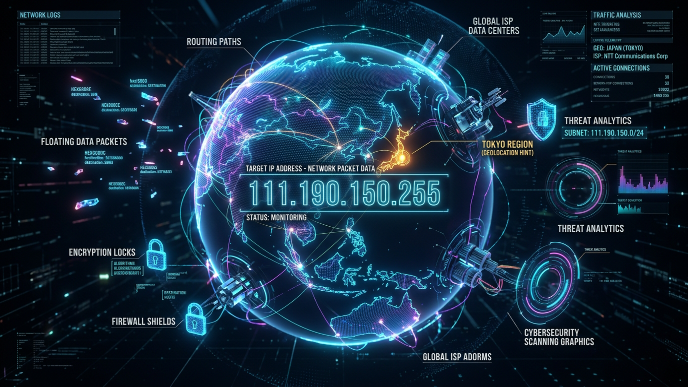
Every device connected to the internet communicates through a unique numerical identifier known as an Internet Protocol (IP) address. These addresses play a critical role in routing data between servers, websites, and user devices across the global network. The IP address 111.190.150.255 is part of the IPv4 system and belongs to a structured range used within internet infrastructure for communication and network management.
In modern networking, IP addresses are widely used for geolocation estimation, ISP identification, cybersecurity monitoring, and traffic routing. Understanding how an IP like 111.190.150.255 works helps users and IT professionals interpret network behavior, detect anomalies, and analyze digital communication patterns. This article provides a complete breakdown of its structure, ownership range, subnet behavior, and security relevance.
What Is 111.190.150.255 in IPv4 Structure?
The IP address 111.190.150.255 is a valid IPv4 address composed of four numerical octets separated by dots. Each octet can range from 0 to 255, forming a 32-bit addressing system that supports billions of unique combinations. IPv4 remains one of the most widely used internet protocols despite the growing adoption of IPv6.
According to IP range data, 111.190.150.0 to 111.190.150.255 represents a single subnet block within a larger allocation. This means the address 111.190.150.255 is part of a structured network segment, often used for routing, broadcasting, or administrative network functions within that subnet.
Subnet Range and Broadcast Role
In networking terms, the IP range 111.190.150.0/24 represents a subnet containing 256 addresses. Within this range, the first address is typically used as the network identifier, while the last address—111.190.150.255—is commonly reserved as the broadcast address.
A broadcast address is used to send data packets to all devices within the same subnet simultaneously. This function is essential for protocols like DHCP and ARP, which help devices discover network configurations and communicate with each other efficiently. Although not assigned to a single device, broadcast IPs play a vital role in local network operations.
This structured segmentation ensures efficient traffic flow, reduces congestion, and improves network management in both enterprise and ISP-level infrastructure.
Geolocation Insights of 111.190.150.255
IP geolocation systems estimate the physical location of an IP address using ISP records, routing data, and registry information. Based on available IP database references, the range 111.190.150.0/24 is associated with infrastructure linked to Malaysia-based hosting or telecom networks.
However, IP geolocation is not always precise. While it can identify a country or region, it does not guarantee the exact physical location of a device. Users may also route traffic through VPNs, cloud servers, or proxy networks, which can alter the visible location of an IP address.
ISP Allocation and Network Ownership
Internet Service Providers (ISPs) are responsible for distributing IP addresses to users, organizations, and data centers. Large IP blocks such as 111.190.150.x are typically assigned to telecom companies or hosting providers that manage internet traffic within a specific region.
According to network registry data, IP ranges like 111.190.150.0/24 are allocated to structured infrastructure providers, which may include broadband services, cloud hosting environments, or enterprise networking systems. These allocations ensure efficient routing and prevent conflicts across the global internet.
ISPs dynamically assign these addresses based on user demand, meaning the same IP may be reused over time for different connections.
How IPv4 Addressing Works in Modern Networks
IPv4 operates on a hierarchical structure designed to support efficient routing and scalability. Each IP address is divided into a network portion and a host portion, allowing routers to identify both the destination network and the specific device or endpoint.
Subnetting, such as /24 blocks, helps divide large networks into smaller manageable segments. This improves performance, enhances security control, and simplifies administrative management. In this structure, 111.190.150.255 represents the final address of its subnet range, reinforcing its role in network-level communication rather than individual device assignment.
Role in Cybersecurity and Threat Monitoring
IP addresses like 111.190.150.255 are widely analyzed in cybersecurity systems for detecting suspicious activity, scanning traffic patterns, and identifying potential threats. Security platforms use IP intelligence databases to evaluate whether an address is associated with malicious behavior, proxy usage, or legitimate traffic.
Research in network security highlights how IP-based monitoring helps detect anomalies and cyberattacks in real time. However, IP addresses alone are not sufficient for identifying users, as attackers often use VPNs or proxy services to mask their identity.
Security systems typically combine IP tracking with behavioral analysis, device fingerprinting, and traffic pattern recognition for better accuracy.
Public vs Private IP Context
It is important to understand the difference between public IP addresses like 111.190.150.255 and private IP ranges used within local networks. Private IPs are reserved for internal use (such as 192.168.x.x or 10.x.x.x ranges), while public IPs are used for internet communication.
Private IPs are not visible on the internet, whereas public IPs are globally routable and can be analyzed through geolocation and ISP databases. This distinction is essential for troubleshooting network issues and understanding how devices connect through routers and ISPs.
Common Misinterpretations About IP Addresses
Many users mistakenly believe that an IP address directly reveals a person’s identity or exact location. In reality, IP addresses provide only approximate geographic information and are often shared among multiple users through NAT (Network Address Translation).
Another common misconception is that IP addresses are static. In most consumer networks, IPs are dynamic and change frequently depending on ISP allocation. This makes long-term tracking based solely on IP data unreliable without additional verification methods.
Importance of IP Knowledge in Digital Era
Understanding IP addresses like 111.190.150.255 is valuable for IT professionals, cybersecurity analysts, developers, and even general internet users. It helps in diagnosing network issues, improving online security awareness, and understanding how global internet infrastructure functions.
As digital systems continue to grow, IP-based communication remains a core foundation of connectivity. Learning how IP allocation, subnetting, and routing work provides deeper insight into how the internet operates behind everyday activities like browsing, streaming, and online communication.
Conclusion
The IP address 111.190.150.255 is part of a structured IPv4 subnet used within global internet infrastructure. It plays a role in network segmentation, broadcast communication, and ISP-managed routing systems. Based on available data, it belongs to a managed IP block associated with telecom or hosting infrastructure, likely in the Asia region.
Understanding its structure, geolocation behavior, and cybersecurity relevance helps users gain a clearer picture of how internet communication works. While IP addresses provide useful technical insights, they should not be treated as exact identifiers of individuals or precise locations. Instead, they are essential building blocks of the modern internet that enable seamless global connectivity.