Introduction to 3474401850 as a Digital Identifier
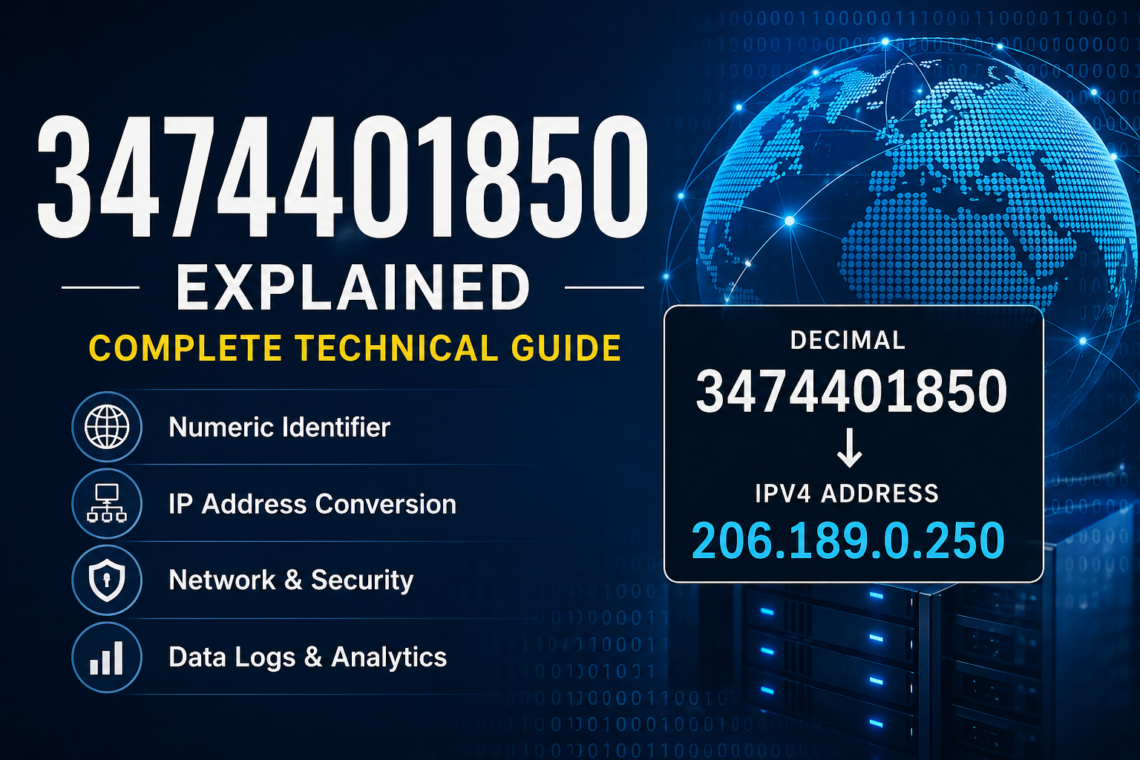
The number 3474401850 is typically understood as a long numeric identifier that can represent different types of digital data depending on the system in which it appears. In computing environments, large integers like this are often used as internal representations of network data, database records, or encoded IP addresses. These numbers are not always meaningful on their own but gain significance when decoded or mapped within a specific technical system.
In modern digital infrastructure, identifiers such as 3474401850 may be associated with IPv4 conversion formats, where IP addresses are stored as 32-bit integers instead of the usual dotted notation. This approach allows systems to process large volumes of network data more efficiently while reducing storage complexity. It is a standard practice in backend systems, analytics platforms, and cybersecurity tools.

Technical Structure and Binary Representation
At a technical level, numbers like 3474401850 are often derived from binary encoding systems used in networking. IPv4 addresses consist of 32-bit binary values, which can be converted into decimal integers for system-level processing. This means a single number can represent an entire IP address when decoded properly.
This numeric format is commonly used in databases and server logs because it allows faster indexing and comparison operations. Instead of storing four separate octets, systems store one integer, making lookups more efficient. This is especially useful in large-scale environments such as cloud computing, traffic monitoring, and routing systems.
The structure itself does not carry human-readable meaning until it is converted back into dotted IP format. However, it plays a critical role in how machines interpret and manage network communication.
Role in Network Systems and Data Handling
In networking environments, identifiers like 3474401850 are used to manage communication between devices across the internet. Every connected device requires an address, and IP-based systems ensure that data packets reach the correct destination.
Large numeric representations are often used in routing tables and firewall configurations. These systems quickly compare integer values rather than parsing string-based IP addresses, which significantly improves performance. This method is widely used in internet service providers, data centers, and enterprise-level networking systems.
Although users never see these numbers directly, they form the backbone of how internet communication is structured and delivered globally.
Connection with IP Address Conversion Mechanisms
The number 3474401850 can be interpreted through IP conversion logic, where decimal values are mapped back into IPv4 format. This conversion process is widely used in system logs and cybersecurity tools to analyze network activity efficiently.
For example, network administrators often encounter IP addresses stored in integer form and convert them into readable formats for debugging or monitoring purposes. This helps identify traffic sources, detect anomalies, and manage network access control systems.
Such conversion mechanisms are essential in understanding how data flows across digital infrastructures, even though end users typically never interact with these numeric forms directly.
Usage in System Logs and Backend Analytics
In backend systems, numeric identifiers like 3474401850 are frequently used in logging mechanisms. Servers generate logs for every request, and IP addresses are often stored in integer format to save space and improve processing speed.
This method allows analytics engines to quickly filter, sort, and analyze traffic data. For example, detecting repeated access attempts or unusual behavior patterns becomes easier when IP data is stored as numbers rather than strings.
As a result, system administrators rely on these numeric values for monitoring performance, diagnosing errors, and maintaining infrastructure stability across high-traffic platforms.
Role in Cybersecurity Monitoring
Cybersecurity systems also rely heavily on numeric IP representations such as 3474401850. These identifiers are used to detect suspicious behavior, track unauthorized access attempts, and identify malicious traffic sources.
Security tools compare incoming IP data against threat databases to determine whether an address is safe or potentially harmful. When stored as integers, this comparison becomes faster and more efficient, allowing real-time threat detection.
This process is crucial for protecting servers, websites, and applications from attacks such as bot traffic, brute force attempts, or distributed denial-of-service (DDoS) activity.
Importance in Data Optimization and Performance
Using numeric identifiers like 3474401850 improves overall system performance by reducing computational overhead. Instead of processing long text-based IP strings, systems handle single integer values that are easier to compute and compare.
This optimization is especially important in large-scale applications such as content delivery networks, cloud storage platforms, and real-time analytics systems. Faster processing leads to better scalability and improved user experience.
By simplifying how IP data is stored and accessed, organizations can handle millions of requests per second without significant delays or performance bottlenecks.
Interpretation Challenges and Misconceptions
One challenge with numbers like 3474401850 is that they can be misinterpreted without proper context. On their own, these values may look like random numbers, but in reality, they often represent structured network data.
Without decoding or system context, it is impossible to determine exact meaning or origin. This leads to confusion among non-technical users who may assume such numbers represent phone numbers, tracking codes, or external identifiers.
Understanding the technical background is essential to correctly interpret what these values represent within digital systems.
Relevance in Modern Internet Infrastructure
Modern internet infrastructure depends heavily on structured addressing systems, and numeric identifiers like 3474401850 are part of this foundation. They support routing, communication, and data exchange between billions of connected devices worldwide.
Every website visit, file download, or online interaction involves IP-based communication in the background. Numeric representations help ensure this process runs smoothly and efficiently across global networks.
As internet usage continues to grow, the importance of optimized data formats like these becomes even more significant in maintaining speed, reliability, and scalability.
Conclusion on the Meaning of 3474401850
The number 3474401850 is best understood as a technical representation used within digital systems rather than a standalone meaningful identifier. It is commonly associated with IP address conversion, system logging, and backend data processing in networking environments.
Its importance lies in how efficiently it supports internet infrastructure, cybersecurity monitoring, and data analytics rather than any direct human-readable meaning. By converting complex IP structures into numeric formats, systems can operate faster and more effectively.
Ultimately, 3474401850 reflects the hidden layer of internet technology that powers communication, security, and data management across modern digital platforms.